How To Make Cookies In Convection Oven The Easy Way
Learning how to make cookies in convection oven is simpler than you think. A convection oven uses a fan to circulate hot air, giving you evenly baked cookies with crispy edges and chewy centers every single time. You will learn the right temperature settings, baking times, and essential cookie baking tips that take your treats from ordinary to amazing. Whether you prefer chocolate chip, sugar cookies, or snickerdoodles, this guide covers everything you need. By the end, you will feel confident baking perfect oven-baked cookies like a pro.
Learning how to make cookies in convection oven is one of the best skills you can pick up in the kitchen. Convection ovens have a fan and a back element that blow hot air around the cooking chamber. This moving hot air surrounds every cookie on the tray, which means no more hot spots or unevenly baked batches. The result? Gorgeous cookies with crispy edges and soft, chewy centers that look bakery-worthy.
Many home bakers worry about using convection for cookies. They think the fan will mess things up. But the truth is, once you understand a few basic principles, convection baking becomes your secret weapon. You get faster bake times, more even results, and cookies that turn out perfectly golden brown every single time. This guide walks you through everything step by step.
Why Convection Ovens Work So Well for Baking Cookies
A regular oven heats from the bottom element. Hot air rises, but it does not move around much. This creates temperature differences inside the oven. The top might be hotter than the bottom. The back might be warmer than the front. When you place cookies on a tray, the ones near the back might bake faster than the ones near the front.
A convection oven fixes this problem. The fan pushes the hot air all around the oven cavity. Every cookie on the tray gets the same amount of heat. This is called even baking, and it is a game changer. You also get better air circulation, which helps cookies bake uniformly. The fan also helps moisture escape faster, which gives you that perfect crispy edge while keeping the center soft.
How To Make Cookies In Convection Oven: The Temperature Secret
Here is the single most important thing to know about how to make cookies in convection oven. You need to lower the temperature. Most cookie recipes are written for standard ovens. If you follow them exactly in a convection oven, your cookies will overbake quickly.
The general rule is simple. Reduce the baking temperature by 25°F from what the recipe says. So if a recipe calls for 350°F, set your convection oven to 325°F. This small change makes a huge difference. Your cookies will bake through without drying out or turning dark too fast.
Understanding Convection Settings on Your Oven
Most modern ovens come with a convection setting. Some ovens have two options: convection bake and convection roast. Convection bake uses a lower fan speed. It works great for cookies, cakes, and pastries. Convection roast uses a higher fan speed and is better for meats and vegetables.
For cookies, always use the convection bake setting. If your oven has a “true convection” or “third-element convection” option, use that. True convection has a fan plus a third heating element behind it. This creates an even more consistent flow of hot air. The result is incredibly uniform baking across every tray.
Quick Tips for Convection Cookie Success
- Always preheat your oven for at least 10 minutes before baking.
- Place the baking tray on the middle oven rack for best results.
- Use a light-colored aluminum baking sheet. Dark pans absorb too much heat.
- Do not crowd the tray. Leave at least 2 inches between each cookie.
- If baking multiple trays, rotate them from top to bottom halfway through.
- Use parchment paper or a silicone baking mat to prevent sticking.
The Best Cookie Recipes for Convection Baking
Not all cookies respond the same way to convection heat. Some cookie types shine in a convection oven, while others need a little extra care. Let us look at the best options and how to adjust them.
Chocolate Chip Cookies in a Convection Oven
Chocolate chip cookies are the most popular cookie type in the world. They also work beautifully in a convection oven. The moving hot air helps the edges get crispy while the center stays soft and gooey. This is exactly what every chocolate chip cookie lover wants.
Start with your favorite cookie recipe and reduce the temperature by 25°F. For most recipes, this means baking at 325°F instead of 350°F. The baking time will be about 8 to 10 minutes. Watch the cookies closely after the 7-minute mark. You want the edges to look golden brown but the centers still look slightly underdone. They will firm up as they cool on the tray.
Sugar Cookies and Snickerdoodles
Sugar cookies and snickerdoodles also do wonderfully in convection ovens. The even heat distribution means every cookie gets the same shape and color. This is especially helpful if you use a cookie cutter to make fun shapes. The consistent hot air helps the edges set quickly, so your shapes hold their form.
For sugar cookies, try baking at 325°F for about 9 to 11 minutes. For snickerdoodles, 325°F for 8 to 10 minutes works perfectly. The cinnamon-sugar coating gets beautifully toasted without burning. You will notice that your snickerdoodles have a more even golden color all the way around.
Chewy Cookies vs Crispy Cookies in Convection Mode
One of the great things about convection baking is how easily you can customize your cookies. Want chewy centers? Pull the cookies out when they look slightly underdone in the middle. They will continue to set as they cool on the hot baking tray. Want crispy cookies? Bake them for an extra minute or two until the entire cookie is golden brown.
The air circulation in a convection oven makes both outcomes easier to achieve. In a standard oven, you often get a mix of crispy and chewy in the same batch. In a convection oven, every cookie gets the same treatment. This consistency is something every home baker appreciates.
How To Make Cookies In Convection Oven: Step-by-Step Instructions
Follow these steps for perfect convection-baked cookies every time.
- Prepare your cookie dough according to your favorite recipe. Chill it for at least 30 minutes if the recipe calls for it.
- Preheat your convection oven to 25°F lower than the recipe suggests.
- Line a light-colored baking sheet with parchment paper or a silicone mat.
- Scoop the dough into balls and place them at least 2 inches apart on the tray.
- Place the tray on the middle rack of the oven.
- Set a timer for 2 to 3 minutes less than the recipe states.
- Check the cookies at the earlier time. Look for golden edges and slightly soft centers.
- Remove the tray and let cookies cool on the baking sheet for 5 minutes before transferring.
Common Mistakes People Make When Baking Cookies in a Convection Oven
Even with a great recipe, mistakes can happen. Here are the most common errors and how to avoid them.
Not Reducing the Temperature
This is the number one mistake. If you bake at the same temperature as a standard oven recipe, your cookies will overbake quickly. The hot air circulation speeds up the cooking process significantly. Always remember to drop the temperature by 25°F.
Overcrowding the Baking Sheet
The fan in a convection oven needs space to move air around. If you place cookies too close together, the air cannot circulate properly. The cookies in the center of the tray will bake differently than the ones on the edges. Give each cookie plenty of room for the best results.
Opening the Oven Door Too Often
Every time you open the oven door, you release the hot air that the fan has been working to circulate. This drops the oven temperature and can affect your baking time. Try to resist the urge to check too frequently. Use the oven light to peek inside instead.
Using the Wrong Pan
Dark, non-stick baking sheets absorb more heat than light-colored aluminum ones. In a convection oven, this can cause the bottoms of your cookies to brown too quickly. Stick with light-colored aluminum or use parchment paper to create a barrier between the cookie and the pan.
Forgetting to Rotate the Tray
Even with a fan, some ovens have slight hot spots. Rotating your tray halfway through the baking time ensures every cookie gets equal exposure to the hot air. This simple step takes only a few seconds but makes a noticeable difference.
Baking Multiple Trays at Once Without Adjustments
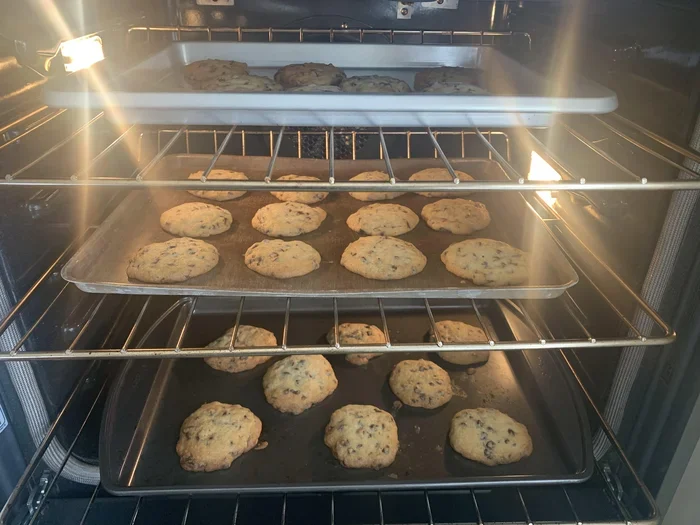
If you want to do batch baking and bake two trays at the same time, you need to be careful. The top tray will bake faster because hot air rises. Consider baking one tray at a time for the most even results. If you must bake two trays, rotate them and switch their positions halfway through.
Expert Insights on Convection Cookie Baking
Professional bakers have long known the advantages of convection ovens. The key is understanding how the moving air changes the baking process. According to baking experts, the fan creates a more uniform heat environment that reduces the need to rotate pans as often. However, a quick half-turn halfway through the bake time still helps with perfection.
The convection setting also works well for cookies with delicate toppings. If you sprinkle streusel, nuts, or decorative sugar on top of your cookies, the even air flow helps these toppings toast evenly. You will never have one side burnt and the other plain again.
Another expert tip is to chill your cookie dough before baking. Cold dough holds its shape better when it hits the hot, fast-moving air of a convection oven. This is especially important for thicker cookies like thick chocolate chip or peanut butter cookies. The cold dough buys you extra time for the edges to set before the center spreads too much.
Adjusting Baking Time for Different Cookie Types
Every cookie type has a different ideal texture. Here is a quick guide for adjusting your convection cookie baking.
- Thin and crispy cookies: Bake at 325°F for 8 to 10 minutes. Let them go a little darker for extra crunch.
- Thick and chewy cookies: Bake at 325°F for 9 to 11 minutes. Pull them out when the centers still look slightly soft.
- Drop cookies: Bake at 325°F for 10 to 12 minutes. These hold their shape well in convection heat.
- Rolled and cut-out cookies: Bake at 325°F for 8 to 10 minutes. The even heat helps preserve intricate shapes.
- Meringue-based cookies: Bake at 275°F for 30 to 45 minutes. The gentle convection dries them out perfectly.
How To Store Your Convection-Baked Cookies
Once you have mastered how to make cookies in convection oven, you will want to keep them fresh. Store fully cooled cookies in an airtight container at room temperature. Most cookies stay fresh for up to 5 days this way. If you bake a big batch, you can freeze baked cookies for up to 3 months. Just thaw them at room temperature before serving.
For soft cookies like chocolate chip or snickerdoodles, place a small piece of bread in the storage container. The bread releases moisture and keeps your cookies soft. For crispy cookies, store them in a container with a loose-fitting lid to keep the air flowing.
The Bottom Line on Convection Cookie Baking
Once you learn how to make cookies in convection oven, you will never go back to a standard oven. The results are simply better. You get more even baking, prettier cookies, and faster bake times. The key is to remember the 25°F temperature reduction and to keep an eye on your cookies a few minutes early. With these simple adjustments, every batch comes out looking and tasting fantastic.
Experiment with different recipes and find your favorites. Try a classic chocolate chip one day and a batch of buttery shortbread the next. Each time, you will notice how the convection oven delivers consistent, beautiful results. Soon, baking cookies in your convection oven will feel second nature.
Practice Makes Perfect
Like any baking skill, convection cookie baking gets easier with practice. Your first batch might not be flawless, and that is okay. Pay attention to how your specific oven behaves. Every convection oven is slightly different. Some run hotter, some have stronger fans. After a few batches, you will know exactly how your oven performs and how to adjust for it.
Keep notes on what works. Write down the temperature you used, the baking time, and how the cookies turned out. Over time, you will build a personal reference guide for your oven. This makes future baking sessions faster and more successful.
Final Thoughts on How To Make Cookies In Convection Oven
How to make cookies in convection oven does not have to be complicated. With the right temperature, proper spacing, and a watchful eye, you can bake cookies that rival any bakery. The convection oven takes the guesswork out of baking and gives you reliable, repeatable results. You get crispy edges, chewy centers, and that beautiful golden brown color on every single cookie.
Start with a simple recipe you already love. Reduce the temperature by 25°F. Set a timer a few minutes early. Check on your cookies and learn how they look at different stages. Before long, you will be baking perfect cookies with confidence. The convection setting is your friend in the kitchen. Embrace it, experiment with it, and enjoy every warm, fresh-from-the-oven cookie.
Quick Recap of Essential Convection Cookie Tips
- Always reduce the recipe temperature by 25°F.
- Use a light-colored baking sheet for even heat distribution.
- Space cookies at least 2 inches apart on the tray.
- Check cookies a few minutes before the recipe suggests.
- Chill your cookie dough for better shape and texture.
- Rotate your tray halfway through for uniform browning.
- Store baked cookies in an airtight container to keep them fresh.
Now that you have all the knowledge you need, it is time to get into the kitchen. Preheat that convection oven, mix up a batch of cookie dough, and enjoy the wonderful aroma of freshly baked treats filling your home. Happy baking.
Key Takeaways
- Lower the temperature by 25°F: Convection ovens cook faster, so reducing heat prevents burnt cookies.
- Use a light-colored baking sheet: Dark pans absorb too much heat and can over-brown your treats.
- Space cookies properly on the tray: Allow at least 2 inches between cookies for even air circulation.
- Check cookies early: Convection baking times are shorter, so start checking a few minutes before the recipe says.
- Chill your cookie dough first: Cold dough holds its shape better in the strong fan-driven heat.
- Rotate your baking tray halfway: This ensures perfectly even browning on all sides.
- Adjust for cookie type: Crispy cookies and chewy cookies need slightly different convection settings.
Frequently Asked Questions
Can I use my regular cookie recipes in a convection oven?
Yes, but you need to make adjustments. Reduce the baking temperature by 25°F and start checking for doneness a few minutes early. Most recipes will work fine in a convection oven with these simple changes. The moving hot air cooks faster, so a little vigilance goes a long way.
What temperature should I set my convection oven for cookies?
For most cookies, set your convection oven to 325°F instead of the standard 350°F. This 25°F reduction prevents overbaking and ensures your cookies come out perfectly golden. Thick or chewy cookies may need closer to 325°F, while thinner crispy cookies can work at 325°F as well. Always watch your cookies closely the first time you try a new recipe.
Do I need special pans for baking cookies in a convection oven?
You do not need special pans, but you should choose wisely. Light-colored aluminum baking sheets work best because they reflect heat evenly. Avoid dark non-stick pans, which absorb too much heat and can cause cookies to overbrown on the bottom. Parchment paper or a silicone baking mat also helps prevent sticking and promotes even baking.
How long do cookies take to bake in a convection oven?
Convection cookies typically bake 3 to 5 minutes faster than in a standard oven. Most cookies take between 8 and 12 minutes at 325°F. Start checking your cookies 2 to 3 minutes before the recipe suggests. Look for golden edges and slightly soft centers, then pull them out. They will continue to firm up as they cool.
Can I bake multiple trays of cookies at once in a convection oven?
Yes, but with some care. Place one tray on the upper-middle rack and one on the lower-middle rack if your oven allows. Rotate both trays and switch their rack positions halfway through baking. If you only have one tray, baking in single batches gives the most even results. The fan works best when air can flow freely around the cookies.
Why do my convection cookies come out too brown on the bottom?
This usually happens when you use a dark baking pan or set the temperature too high. Dark pans absorb extra heat, and convection ovens already cook faster than standard ovens. Switch to a light-colored aluminum sheet and reduce your temperature by 25°F. Also, placing parchment paper between the cookie and the pan can help prevent over-browning on the bottom.
=== CONCLUSION ===
Learning how to make cookies in convection oven opens up a world of baking possibilities. You get faster results, more even baking, and cookies with perfect crispy edges and soft centers every time. The key takeaways are simple: reduce the temperature by 25°F, space your cookies properly, and keep an eye on them a few minutes early. These small adjustments make a massive difference in your final results.
Whether you are baking chocolate chip cookies for a family gathering or sugar cookies for the holidays, your convection oven will deliver consistent, beautiful outcomes. The convection setting takes the guesswork out of baking and gives you reliable results batch after batch. With the cookie baking tips and baking tips shared in this guide, you are well equipped to tackle any cookie recipe with confidence.
So preheat that oven, grab your favorite cookie dough recipe, and start baking. The warm, delicious aroma of fresh oven-baked cookies filling your kitchen is one of life’s simple pleasures. Enjoy every bite, and happy baking!