How To Calibrate Amana Oven For Better Cooking Results
Learning how to calibrate your Amana oven is one of the simplest ways to transform your cooking results. An uncalibrated oven can throw off temperatures by 25 degrees or more, leading to undercooked or burnt dishes. This guide walks you through the entire calibration process using easy-to-follow steps, practical tips, and expert insights. You will learn what tools you need, how to test your oven’s accuracy, and how to fix common temperature problems. By the end, you will know exactly how to get your Amana oven running at the right temperature every single time.
Cooking at home should feel rewarding, not frustrating. Yet many home cooks deal with one hidden problem every single day: their oven lies about the temperature. You set it to 350 degrees, but the actual inside temperature could be 325 or 375. That difference changes everything. Cookies spread too thin. Cakes sink in the middle. Roasted chicken comes out dry on the outside and raw on the inside. The good news is that fixing this problem is easier than most people think. In this guide, we walk you through exactly how to calibrate Amana oven models step by step. Whether you own a classic range or a modern double oven, the process is straightforward and does not require any special skills. By the time you finish reading, you will have the confidence and knowledge to make your oven run true again.
Temperature accuracy is the foundation of great cooking. When your oven heats to the correct temperature, food cooks evenly, textures turn out right, and flavors develop properly. An oven that runs hot or cold ruins even the best recipes. Many people blame themselves or their ingredients when dishes fail, but the real culprit is often the oven itself. Calibration fixes this at the source. It adjusts the oven’s internal settings so the displayed temperature matches the actual temperature inside the cavity. Think of it like tuning a musical instrument. Once it is in tune, everything sounds right. Once your Amana oven is calibrated, everything you cook will turn out better. Let us dive into the details.
Key Takeaways
- Calibration matters: A properly calibrated Amana oven ensures your food cooks evenly and at the right temperature every time.
- Simple tools needed: An oven thermometer and a basic screwdriver are all you need to get started with the calibration process.
- Easy step-by-step process: You can calibrate your oven in under 30 minutes using the methods outlined in this guide.
- Common problems are fixable: Issues like inaccurate readings, uneven heat, and persistent temperature swings often have straightforward solutions.
- Regular maintenance helps: Scheduling periodic checks keeps your Amana oven performing at its best for years to come.
- Know when to call a pro: Some calibration issues require professional attention, especially when the temperature sensor or control board fails.
📑 Table of Contents
- Why Oven Calibration Matters For Your Cooking
- Tools You Need To Calibrate Your Amana Oven
- Step-By-Step Guide To Calibrating Your Amana Oven
- Common Calibration Problems And How To Fix Them
- Tips For Maintaining Accurate Oven Temperatures
- When To Call A Professional For Oven Calibration
- Final Thoughts On Calibrating Your Amana Oven
Why Oven Calibration Matters For Your Cooking
Most people never think about oven calibration until something goes wrong. But understanding why it matters can change the way you cook forever. An uncalibrated oven does not just affect one dish. It affects every single thing you bake, roast, or broil. Let us look at the real reasons calibration deserves your attention.
The Hidden Cost Of Inaccurate Temperatures
When your oven runs 25 degrees too hot, you lose more than just precision. Moisture escapes faster. Sugars caramelize too early. Proteins seize up before the inside has a chance to cook through. The result is food that looks done on the outside but is undercooked within. On the flip side, an oven running too cold means you leave food in longer. This dries it out and changes its texture completely. Both scenarios waste ingredients, time, and energy.
Beyond food quality, inaccurate temperatures can create safety concerns. Poultry and meats need to reach specific internal temperatures to be safe to eat. If your oven runs cold, you might think the food is cooked when it is not. Using a reliable oven thermometer alongside proper calibration helps you avoid this risk entirely.
How Often Should You Calibrate Your Oven?
Most oven manufacturers recommend checking calibration at least once a year. However, some signs tell you it is time to check sooner:
- Food consistently burns on the edges but stays raw in the center
- Baking times have increased without any recipe changes
- Your oven makes unusual noises during the preheat cycle
- You notice visible temperature differences between racks
- The oven has recently been moved or impacted
- You have not calibrated the oven in over a year
If you notice any of these signs, take a few minutes to run a calibration check. It is a small effort that pays off big time in the kitchen.
Tools You Need To Calibrate Your Amana Oven
Before you start the calibration process, gather the right tools. You do not need anything fancy or expensive. The basics are simple and easy to find at any hardware store or online.
Essential Calibration Tools
Here is what you will need on hand before you begin:
- Oven thermometer: This is the most important tool. A standalone oven thermometer lets you measure the actual temperature inside your oven cavity. Place it on the middle rack for the most accurate reading. Digital thermometers tend to be more precise than analog ones, but both work well.
- Screwdriver set: Most Amana ovens use a small flathead or Phillips screwdriver to access the calibration screw behind the temperature knob. Check your model’s manual to confirm the type needed.
- Notebook and pen: You will want to record your temperature readings before and after calibration. This helps you track improvements and spot patterns over time.
- Timer or phone: You need to track preheat times and temperature stabilization periods accurately.
Optional But Helpful Tools
While not strictly necessary, a few extra tools can make the process smoother:
- Infrared thermometer: This lets you check the temperature of specific oven surfaces without opening the door.
- Multi-meter: Useful if you need to test the oven’s temperature sensor or bake element for electrical continuity.
- Owner’s manual: Always keep this handy. Different Amana models have slightly different calibration procedures, and the manual has the exact instructions for your unit.
Having these tools ready before you start means you will not need to pause mid-process. That keeps the calibration smooth and efficient.
Step-By-Step Guide To Calibrating Your Amana Oven
Now that you have your tools, let us walk through the actual calibration process. Follow these steps carefully, and you will have your Amana oven reading true temperatures in no time.
Step One: Test Your Current Temperature
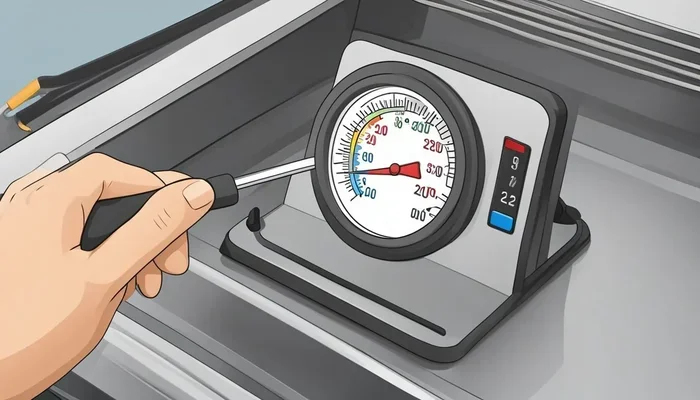
Start by placing your oven thermometer on the middle rack. Close the door and set the oven to 350 degrees Fahrenheit. Wait for the oven to preheat fully. Most ovens signal readiness with a light or beep, but do not trust that signal alone. Give the oven an extra 15 to 20 minutes after the preheat indicator turns off. This allows the temperature to stabilize throughout the cavity.
Once the oven has been at 350 for at least 20 minutes, read the thermometer. Write down the temperature. Now compare it to the setting on the dial or display. If the thermometer reads 350, your oven is already calibrated and you are done. If it reads higher or lower, you have work to do. Note the difference, as this number tells you how much adjustment is needed.
Step Two: Access The Calibration Screw
Turn off the oven and let it cool completely. The calibration screw is typically located behind the temperature knob on the front control panel. Gently pull the knob straight off. On some Amana models, you may need to press a small release tab underneath while pulling. Once the knob is off, you will see a small screw set into the shaft of the knob.
Take a close look at the screw. It usually has a small slot or cross pattern. This is the adjustment point. Be gentle with this part. You are making a fine adjustment, not forcing anything. If the screw looks corroded or stuck, a small drop of penetrating oil can help loosen it.
Step Three: Adjust The Temperature
This is where the actual calibration happens. Using your screwdriver, turn the calibration screw in the appropriate direction. Here is the general rule:
- If your oven runs too hot: Turn the screw counterclockwise. This lowers the temperature setting.
- If your oven runs too cold: Turn the screw clockwise. This raises the temperature setting.
Make small adjustments. A quarter turn at a time is usually plenty. After each adjustment, put the knob back on, set the oven to 350 degrees, and test again. Repeat this process until the thermometer matches the set temperature. Most Amana ovens allow for an adjustment range of about 30 to 35 degrees in either direction.
Step Four: Verify The Calibration
Once you have made the adjustment, run a full verification test. Set the oven to 350 degrees and wait for it to preheat and stabilize. Check the thermometer reading again. It should now match the set temperature within 5 degrees. If it does, you are good to go. If not, repeat the adjustment process with smaller turns of the screw.
Some people like to test at multiple temperatures, such as 250 and 450 degrees, to ensure accuracy across the range. This extra step is especially helpful if you do a lot of baking or roasting at different temperatures. It gives you confidence that the calibration holds true throughout the oven’s full operating range.
Common Calibration Problems And How To Fix Them
Sometimes the calibration process reveals deeper issues. Here are the most common problems people encounter and how to address them.
Oven Runs Hot Even After Adjustment
If your oven still runs hot after calibration, the problem may be with the bake element. When the bake element develops hot spots or starts to fail, it heats unevenly and often runs hotter than it should. To check the bake element, look for visible damage like blistering, cracking, or glowing unevenly when the oven is on. A failing bake element usually needs replacement rather than further calibration adjustment.
Oven Runs Cold Or Takes Too Long To Preheat
A slow preheat or consistently low temperature can point to a weak bake element or a faulty temperature sensor. The sensor is a small probe located at the back of the oven cavity. It tells the oven’s control board what the current temperature is. If the sensor is damaged or misaligned, the oven cannot regulate temperature properly. You can test the sensor using a multi-meter to check for continuity. Most sensors should read between 1000 and 1100 ohms at room temperature.
Temperature Varies Between Racks
If you notice different temperatures on different racks, the problem is often air circulation. Check that nothing is blocking the vents inside the oven. Overcrowding the oven also restricts airflow and creates hot and cold zones. For the most even results, avoid opening the door frequently during cooking, as this lets heat escape and disrupts the internal temperature balance.
Calibration Screw Does Not Work
In rare cases, the calibration screw may not affect the temperature at all. This usually means the oven’s control board or thermostat is malfunctioning. These components require professional diagnosis and repair. If you have tried the calibration process and see no change, it is time to call in a qualified technician.
Tips For Maintaining Accurate Oven Temperatures
Calibration is not a one-time fix. It is part of regular oven maintenance. Here are practical tips to keep your Amana oven performing accurately for years.
Clean Your Oven Regularly
Food debris and grease buildup inside the oven can affect temperature accuracy. Burnt-on residue absorbs heat and radiates it unevenly, creating hot spots. Clean your oven interior at least once a month. A gentle cleaner and a soft cloth work well for routine cleaning. Avoid harsh abrasives that can damage the oven’s interior surfaces.
Use The Right Cookware
The type of cookware you use affects how heat distributes inside the oven. Dark, heavy pans absorb more heat and can cause foods to brown faster. Light-colored aluminum pans reflect heat and promote more even cooking. If you are troubleshooting temperature issues, try switching to a different pan type and see if the results improve.
Avoid Opening The Oven Door Too Often
Every time you open the oven door, you lose heat and disrupt the temperature balance. This is especially true during the first 10 to 15 minutes of cooking, when the oven is working hard to maintain the set temperature. Trust your timer and the oven light to check on your food instead of opening the door repeatedly. If you must check, do it quickly and close the door right away.
Consider Using A Second Thermometer
For the most accurate readings, place a second thermometer on a different rack. This helps you identify hot and cold zones inside the oven. Once you know where the temperature varies, you can adjust your cooking placement accordingly. This simple trick works wonders for even baking and roasting.
Remember, maintaining proper temperature is especially important when cooking foods that need precise heat. For instance, if you are making dishes that require very specific oven conditions, like preparing a tandoori-style dish, temperature accuracy becomes even more critical for achieving authentic results.
When To Call A Professional For Oven Calibration
Most calibration issues can be fixed at home with the steps outlined above. But some situations call for professional help. Knowing when to make that call saves you time, money, and frustration.
Call a technician if you notice any of the following:
- The oven temperature sensor shows no continuity when tested with a multi-meter
- The control board displays error codes that do not go away after a reset
- The oven makes sparking, buzzing, or burning smells during operation
- Calibration adjustments have no effect on temperature readings
- The bake element visibly glows unevenly or does not heat at all
Professional technicians have specialized diagnostic tools and replacement parts that are not available to the average home cook. They can quickly identify whether the issue is with the sensor, the control board, the heating element, or another component. Attempting complex repairs without the right knowledge can void your warranty or cause further damage.
Also, if your Amana oven is still under warranty, contact the manufacturer before attempting any repairs yourself. Many warranty repairs are free or low-cost and ensure your oven remains covered for future issues.
When cooking with a properly calibrated oven, you can trust that your recipes will perform as expected. Whether you are following a detailed recipe or experimenting with your own creations, knowing your oven’s temperature is accurate gives you a huge advantage. For those who love oven-baked dishes like stuffed rouladen, precise temperature control ensures the meat stays juicy and the filling cooks through perfectly every single time.
Final Thoughts On Calibrating Your Amana Oven
Calibrating your Amana oven is one of the most worthwhile things you can do for your kitchen. It takes less than an hour, costs almost nothing, and delivers immediate improvements in your cooking results. Food tastes better. Baking turns out more consistent. You waste less food and save money in the long run.
Do not let an uncalibrated oven hold you back from making your best dishes. Grab an oven thermometer, follow the steps in this guide, and feel the difference right away. Once your oven is running true, you will wonder how you ever cooked without checking the temperature first.
Remember, a well-maintained oven is the heart of a great kitchen. Regular calibration, cleaning, and care keep it working its best for years to come. Make calibration part of your seasonal kitchen routine, and your cooking will thank you every single day.
One last safety reminder: always unplug the oven or turn off the circuit breaker before performing any internal checks or adjustments. Safety comes first in every kitchen task. With the right knowledge and a little patience, you will master the art of oven calibration and enjoy better cooking results from this point forward.
And if you are ever unsure about what can go inside your oven safely, check out our guide on whether it is safe to put a pizza box in the oven for important safety tips that every home cook should know.
Frequently Asked Questions
How do I know if my Amana oven needs calibration?
The most reliable way is to use an oven thermometer. Set your oven to 350 degrees and check the actual temperature after it preheats. If the reading differs by more than 15 degrees from the set temperature, your oven needs calibration. Other signs include uneven cooking, burning on the edges, and consistently long baking times.
Can I calibrate my Amana oven without any special tools?
You need at least an oven thermometer to verify the temperature. A screwdriver is also necessary to adjust the calibration screw. These are inexpensive and widely available. Without them, you cannot accurately test or adjust the oven temperature.
How much can I adjust the temperature on my Amana oven?
Most Amana ovens allow an adjustment range of approximately 30 to 35 degrees in either direction. If your oven needs more adjustment than this, there may be a deeper mechanical issue that requires professional attention.
How often should I recalibrate my Amana oven?
Once a year is a good general rule. However, if you notice temperature inconsistencies or your cooking results change, check the calibration sooner. Ovens can drift over time due to wear on internal components.
Is oven calibration the same as oven repair?
No, calibration is an adjustment to the existing settings. It does not fix broken parts. If your oven has a faulty sensor, damaged bake element, or malfunctioning control board, those require repair or replacement. Calibration simply fine-tunes the temperature accuracy of a working oven.
Will calibrating my oven improve energy efficiency?
Yes, it can. When your oven runs at the correct temperature, it does not need to work as hard or run as long to cook your food. This can reduce energy consumption slightly over time and contribute to lower utility bills.
=== CONCLUSION ===
Learning how to calibrate Amana oven is a simple skill that pays off every time you cook. Accurate temperatures mean better food, less waste, and more confidence in the kitchen. The process is straightforward, requires minimal tools, and takes less than an hour to complete. Make it part of your routine, and you will notice the difference from the very first meal. Your oven works hard for you. Give it the care it deserves, and it will reward you with perfectly cooked dishes day after day.