Where To Put Oven Thermometer For Best Baking Results
Knowing where to put oven thermometer is the simplest way to transform your baking results. Most ovens run hot or cold in certain zones, and a thermometer reveals the truth. Place it correctly, and you unlock even baking, better browning, and far fewer kitchen disasters.
Have you ever followed a recipe perfectly and still ended up with burnt edges or a sunken middle? The problem might not be your technique. It could be your oven lying to you. Most home ovens have temperature swings of 25 to 50 degrees, and many run consistently hotter or cooler than what the dial says. That is exactly why where to put oven thermometer matters so much.
A simple oven thermometer takes the guesswork out of baking. But here is the catch: where you place it changes everything. Put it in the wrong spot, and you will get false readings. Put it in the right spot, and you unlock consistent, reliable results every single time. In this guide, we walk through the exact placement strategies that deliver accurate oven temperature and better baking outcomes.
Whether you are a beginner or a seasoned baker, understanding thermometer placement in oven is one of the easiest upgrades you can make. Let us dive in.
Key Takeaways
- Center rack placement works best: This is where heat circulates most evenly, giving you the most accurate reading.
- Avoid the oven door and walls: These areas experience temperature swings and can skew your readings significantly.
- Choose between analog and digital thermometers: Each type has its own ideal placement strategy for accurate results.
- Watch for hot spots and cold zones: Every oven has them, and knowing their location changes everything about your baking.
- Calibrate regularly: Even the best oven thermometer drifts over time, so recheck it every few months.
- Placement affects more than just temperature: It impacts browning, rising, moisture retention, and overall food safety.
📑 Table of Contents
- Why Your Oven Needs a Thermometer
- Best Places to Position Your Oven Thermometer
- Types of Oven Thermometers and How Placement Varies
- Common Mistakes People Make With Oven Thermometer Placement
- How to Calibrate Your Oven Thermometer
- Pro Tips for Perfect Baking Every Time
- How Placement Affects Different Types of Baking
- When to Replace Your Oven Thermometer
- Final Thoughts on Oven Thermometer Placement
Why Your Oven Needs a Thermometer
Most ovens come with a built-in temperature dial. Sounds convenient, right? The problem is that these dials are often inaccurate. Over time, the internal thermostat can drift. The heating element wears out. The seal around the door gets loose. All of these factors affect oven temperature accuracy.
Here is what happens when your oven lies to you:
- Baked goods rise unevenly because one side of the pan faces more heat.
- Cookies spread too much or burn when the actual temperature runs higher than set.
- Cakes fall in the center when the oven is too cool and the batter sets too slowly.
- Food safety suffers because you cannot trust that meats reach safe internal temperatures.
An external thermometer removes all that guesswork. But only if you place it correctly. Where to put oven thermometer is not just a placement question. It is a precision question.
The Science Behind Oven Heat Distribution
Heat inside an oven does not spread evenly. Hot air rises, and cooler air sinks. This creates natural convection patterns. In a standard thermal oven, the top gets hotter and the bottom gets cooler. In a convection oven, the fan pushes air around, but even then, some zones stay warmer than others.
These patterns are called oven hot spots and cold zones. They vary from oven to oven based on size, age, and design. The only way to map them is with a thermometer placed at the right height and position.
When you understand your oven’s unique personality, you can adjust baking temperature and rack position accordingly. This is the foundation of even baking.
Best Places to Position Your Oven Thermometer
This is the heart of the article. Let us break down the exact spots that work best for oven thermometer placement.
On the Center Oven Rack
The center rack is the gold standard for thermometer placement. Here is why:
- Heat distributes most evenly at this level.
- It sits far enough from the top and bottom elements to avoid direct radiant heat.
- It gives you a reading that closely matches where your food actually sits.
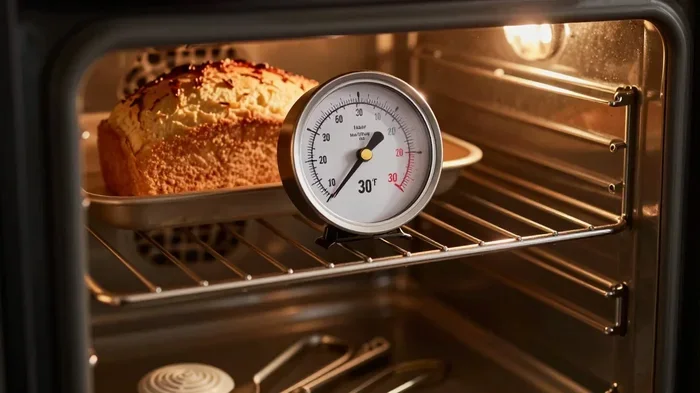
Hang your thermometer from the center rack using the hook or clip. Make sure it sits in the middle of the oven, not touching the walls or the rack itself. This position gives you the most reliable temperature reading for everyday baking.
At Mid-Height on the Oven Wall
If you do not have room on the center rack, the middle of the side wall works as a solid alternative. Place the thermometer about halfway up the oven cavity. This keeps it away from both the top and bottom heating elements.
Just make sure it does not touch the glass door or the oven wall directly. Contact with metal or glass can give you a skewed temperature reading that does not reflect the actual air temperature inside.
On the Lower Third Rack
Sometimes you need to know what the bottom of your oven is doing. This is especially true for pizza baking, bread baking, or any recipe that calls for a very hot bottom heat.
Place the thermometer on the lower rack to check for oven hot spots near the floor. Many ovens run significantly hotter at the bottom because the lower heating element cycles on more frequently.
This placement also helps you understand how much heat radiates upward. It is a great way to troubleshoot uneven browning on the bottom of your bakes.
Types of Oven Thermometers and How Placement Varies
Not all thermometers are the same. The type you choose affects where it should go and how you read the results.
Analog Dial Thermometers
These are the classic hanging thermometers with a round dial face. They are affordable, durable, and do not need batteries. Most analog thermometers hang from a hook or sit on a rack.
Best placement: Hang from the center rack. The dial should face outward so you can read it through the oven door without opening it. Avoid placing them too close to the back wall, where heat concentrates.
One advantage of analog thermometers is that they give you a continuous visual reading. You can watch the temperature climb in real time. This makes them great for learning how your oven behaves during preheating.
Digital Probe Thermometers
Digital probe thermometers offer more precision. They come with a thin metal probe that goes inside the oven and a digital readout that stays outside. Some models have wireless connectivity so you can monitor temperature from your phone.
Best placement: Insert the probe into the center of the oven cavity, ideally at food height. The digital display unit should sit outside the oven on the counter. Make sure the wire does not touch any hot surfaces.
Digital thermometers are excellent for baking accuracy because they respond faster than analog models. They also let you track temperature fluctuations over time, which helps you understand your oven’s patterns.
Infrared Thermometers
Infrared thermometers measure surface temperature, not air temperature. They are handy for checking how hot your oven rack, stone, or pan gets. But they do not replace a traditional oven thermometer for air temperature readings.
Best placement: Point the infrared gun at the oven rack surface or baking stone. This helps you identify radiant heat zones that affect how your pan heats up.
Common Mistakes People Make With Oven Thermometer Placement
Even experienced bakers get this wrong. Avoid these common placement mistakes to get the most accurate readings.
Placing It Too Close to the Door
The oven door is the weakest point for temperature control. Every time you open it, heat escapes and cold air rushes in. A thermometer sitting near the door will register fluctuating temperatures that do not represent the true baking environment.
Keep your thermometer at least three to four inches away from the door glass. This gives you a reading from the stable interior air, not the turbulent zone near the opening.
Letting It Touch the Oven Walls or Rack
Metal conducts heat differently than air. If your thermometer touches the wall or the rack, it will read higher than the actual air temperature. This is one of the most common reasons people think their oven is hotter than it really is.
Always allow a small gap between the thermometer bulb and any metal surface. A good rule of thumb is to keep it at least one inch away from any solid surface.
Ignoring the Preheating Phase
Many people check their oven thermometer only after it has been at temperature for a while. But the preheating phase tells you a lot. Does your oven overshoot? Does it take too long to stabilize?
Watch your oven thermometer during preheat and note the peak temperature before it settles. This gives you a fuller picture of your oven’s performance and helps you make adjustments to your baking temperature settings.
Using Only One Thermometer
Your oven likely has temperature variation from top to bottom and front to back. A single thermometer gives you one data point. For a more complete picture, consider using two thermometers at different rack levels.
This is especially helpful if you bake frequently or own a larger oven with multiple racks. Understanding the full temperature gradient inside your oven takes your baking to the next level.
How to Calibrate Your Oven Thermometer
Even the best oven thermometer can drift over time. Calibration ensures your readings stay trustworthy. Here is how to do it.
The Boiling Water Test
Fill a pot with water and bring it to a rolling boil. Place your thermometer near (not in) the steam. At sea level, water boils at 212 degrees Fahrenheit. If your thermometer reads significantly different, it needs recalibration.
Most analog thermometers have a small calibration nut on the back of the dial. Use a pair of pliers to gently adjust it until the reading matches 212 degrees. Digital thermometers often have a calibration button in the settings menu.
The Ice Water Test
Fill a glass with ice and add cold water. Stir it and wait 30 seconds. Place your thermometer probe in the slush. It should read 32 degrees Fahrenheit. This test checks the low end of your thermometer’s range.
Running both tests gives you confidence that your baking thermometer is accurate across the full temperature spectrum. Calibrate every three to six months for best results.
Pro Tips for Perfect Baking Every Time
Placement is only part of the equation. Here are some expert-level tips that tie everything together.
Map Your Oven Before You Bake
Before any important bake, run a temperature test. Place your thermometer on the center rack and preheat to 350 degrees. Wait 20 minutes after the oven beeps and note the actual temperature. Then move the thermometer to the upper rack and repeat. Do the same on the lower rack.
Write down the readings. Over time, you build a temperature map of your oven. This map becomes your personal baking guide and eliminates a lot of guesswork.
Use a Timer and a Thermometer Together
Temperature and timing work as a team. If your oven runs 25 degrees hot, you may need to reduce the set temperature by 25 degrees or shorten the bake time. A thermometer tells you the truth so you can adjust accordingly.
Rotate Your Pans Halfway Through
Even with perfect thermometer placement, some oven hot spots remain. Rotating your pans 180 degrees halfway through the bake helps compensate for uneven heat. This simple habit dramatically improves even baking results.
Trust Your Thermometer More Than Your Oven Dial
Your oven dial is a suggestion. Your thermometer is the truth. Always let the thermometer guide your decisions about baking temperature and oven calibration. Over time, you will develop an intuition for how your specific oven behaves.
Clean Your Thermometer Regularly
Grease and food residue can build up on the thermometer bulb and affect accuracy. Wipe it down with a damp cloth after each use. For stubborn residue, use a mild soap and warm water. A clean thermometer gives you more reliable oven temperature readings.
How Placement Affects Different Types of Baking
Different baked goods respond to temperature in different ways. Understanding this helps you decide where to position your thermometer and your food.
Bread and Pizza
Bread and pizza love high heat from below. Place your thermometer on the lower rack to check the floor temperature. If your oven hot spots are near the back, position your pizza stone or baking steel there for maximum crispness.
Cakes and Cupcakes
Cakes need steady, even heat. The center rack is your best friend. Place the thermometer there and aim for a consistent 325 to 350 degrees. Avoid opening the door frequently, as this causes temperature drops that can make cakes sink.
Cookies and Pastries
Cookies benefit from knowing exactly where the even heat zones are. Place the thermometer on the center rack and bake one tray at a time for the most consistent results. If you must bake two trays, rotate them top to bottom and front to back halfway through.
Casseroles and Roasted Dishes
For casseroles and roasts, place the thermometer at the height where the food sits. Most casseroles bake on the center rack, so that is where you want your reading. This ensures the baking temperature matches the actual environment surrounding your dish.
When to Replace Your Oven Thermometer
Even with proper care, thermometers wear out. Analog dial thermometers can lose accuracy after a year or two of regular use. Digital probes may develop lag or give inconsistent readings.
Signs it is time for a replacement:
- The thermometer consistently reads more than 15 degrees off after calibration.
- The dial face is cracked or the needle sticks and does not move freely.
- The digital display flickers, shows error codes, or responds slowly.
- The probe wire is frayed or damaged near the connection point.
A good oven thermometer costs between 10 and 25 dollars. Replacing it regularly is a small investment that pays off in baking accuracy and better results every time you use the oven.
Final Thoughts on Oven Thermometer Placement
Getting where to put oven thermometer right is one of the simplest yet most powerful things you can do for your baking. It takes five minutes to set up, costs very little, and delivers immediate improvements in baking results.
Start with the center rack position. Hang your thermometer so it does not touch any surfaces. Watch it during preheat. Note the actual temperature and adjust your recipes accordingly. Over time, you will develop a deeper understanding of your oven and how it behaves.
The difference between a good baker and a great baker often comes down to details. Oven thermometer placement is one of those details that makes a real, measurable difference. Trust your thermometer, calibrate it regularly, and let it guide your baking decisions. You will wonder how you ever baked without it.
Take action today. Grab your oven thermometer, place it in the center of the oven, and run a test bake. You might be surprised by what you discover. Once you see the real temperature inside your oven, you will never go back to guessing again.
Frequently Asked Questions
Where should I place my oven thermometer for the most accurate reading?
The center oven rack is the best spot. It sits in the zone where heat circulates most evenly, giving you a reading that closely matches where your food actually bakes. Hang it in the middle of the rack and make sure it does not touch the oven walls or the rack itself.
Can I put my oven thermometer on the oven floor?
You can, but it will likely read higher than the actual air temperature because the oven floor absorbs and radiates direct heat from the bottom element. For the most accurate air temperature reading, always place the thermometer on a rack in the center of the oven cavity.
How do I know if my oven thermometer is accurate?
Perform the boiling water test and the ice water test. At sea level, boiling water should read 212 degrees Fahrenheit and ice water should read 32 degrees Fahrenheit. If your thermometer is off by more than 5 degrees in either test, recalibrate it or consider replacing it.
Does oven thermometer placement affect baking results?
Absolutely. If your thermometer sits near the door or against the wall, it will give false readings that lead you to set the wrong temperature. Correct placement ensures you bake at the true temperature, which directly impacts how your food rises, browns, and cooks through.
Should I use more than one oven thermometer?
Yes, if you bake often. Using two thermometers at different rack levels helps you understand the temperature gradient inside your oven. This is especially useful for larger ovens or when you bake on multiple racks at once. It gives you a much clearer picture of oven temperature accuracy across the entire cavity.
How often should I check or recalibrate my oven thermometer?
Check it every few months and recalibrate at least twice a year. Thermometers can drift over time due to wear, heat exposure, and age. Regular checks ensure your baking temperature remains reliable and your results stay consistent.
=== CONCLUSION ===
Where to put oven thermometer is one of those small adjustments that delivers big results. The center rack, away from walls and the door, gives you the most accurate picture of what is really happening inside your oven. Pair that correct placement with regular calibration and a little patience, and you will notice a difference in every bake.
Your oven is a tool, and like any tool, it works best when you understand how it truly performs. An oven thermometer is the window into that performance. Use it wisely, trust the numbers it gives you, and let those numbers guide your baking decisions. The result is more consistent loaves, better cookies, perfectly risen cakes, and the confidence that comes from knowing your oven is telling the truth.
Start today. Place your thermometer correctly, run a test, and adjust from there. Better baking starts with one simple step, and that step is knowing where to put oven thermometer in your kitchen.